sanco365seo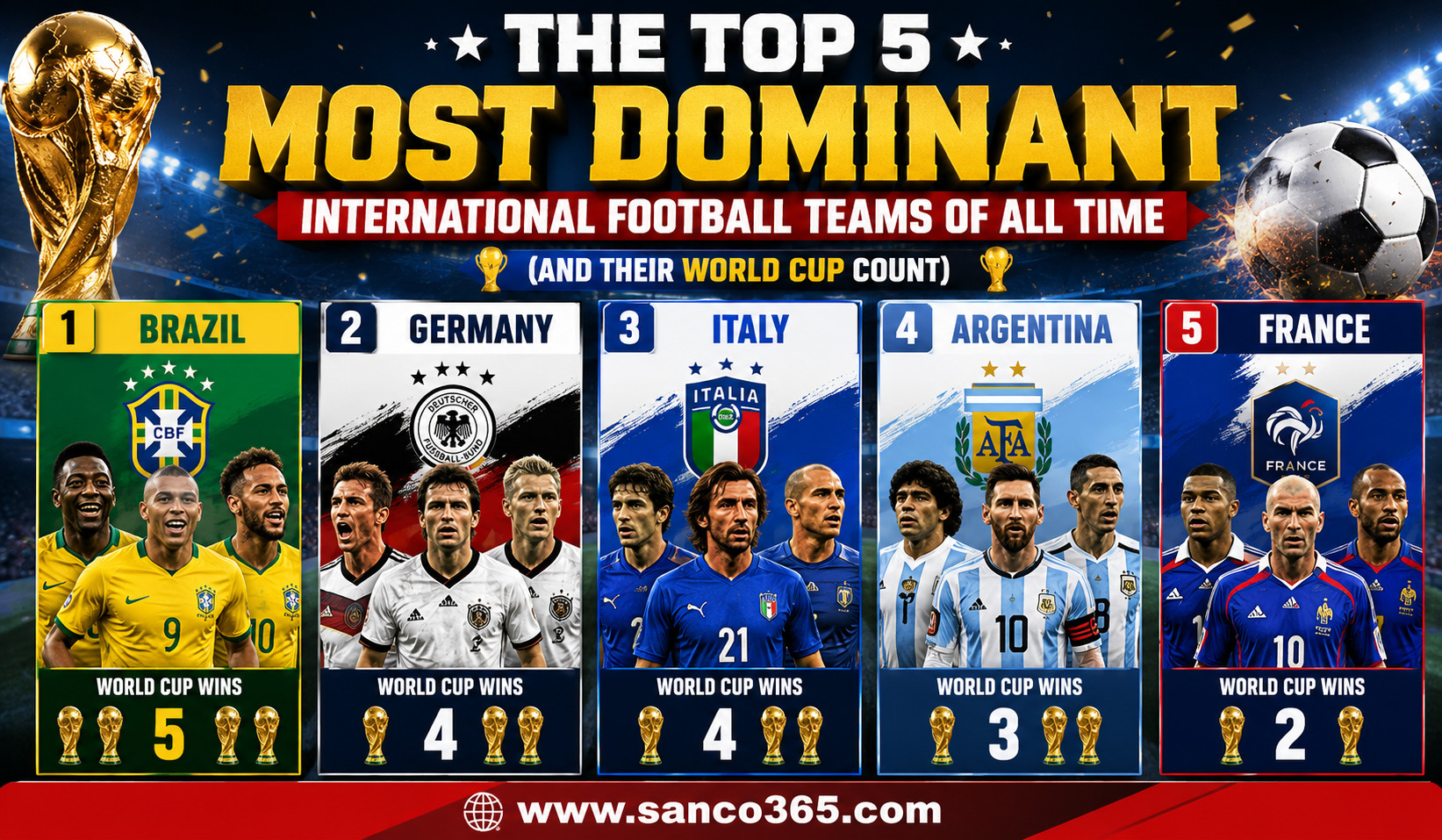
Some international football teams win a tournament. A rare few redefine what winning even looks like for years at a stretch, stacking trophies and unbeaten runs until rival nations stop asking whether they can be beaten and start asking when. This countdown looks at the five national sides that turned international football dominance into a sustained era rather than a single golden summer, ranked by trophies won, streaks built, and the sheer weight of history each of them left behind.
What Actually Makes an International Side “Dominant”?
Club football dominance is usually measured in league titles and Champions League runs, spread across dozens of matches a season. International football dominance works on a completely different clock, since national teams might play fifteen to twenty matches in a good year and only get one real shot at a major trophy every twelve to twenty four months. That is what makes the teams on this list so remarkable. Building genuine international football dominance means winning back to back major tournaments, stringing together historic unbeaten runs, and doing it against opponents who have years, not weeks, to prepare a specific plan to stop you.
5. West Germany, 1972 to 1974
West Germany’s early seventies side is often overshadowed by the golden generations that came before and after it, but the achievement itself stands on its own. Franz Beckenbauer’s team won the 1972 European Championship playing some of the most fluid, attacking football the continent had seen, then backed it up two years later by lifting the 1974 World Cup on home soil. Winning the Euros and the World Cup back to back, with largely the same core group of players, is a feat that has been matched by very few nations since.
Gerd Muller’s finishing and Beckenbauer’s redefinition of the sweeper role gave this West Germany side a blend of attacking firepower and tactical intelligence that opponents simply had no answer for across two full tournament cycles.
4. Hungary’s Golden Team, 1950 to 1954
Hungary’s Mighty Magyars belong on any list of the most dominant international football teams ever assembled, even though their story ends in heartbreak. Between 1950 and 1954, Hungary went thirty one matches without a defeat, a run that included Olympic gold at the 1952 Helsinki Games and a stretch of results so lopsided that the team earned its nickname for a reason. Ferenc Puskas led a side that famously beat England 6-3 at Wembley in 1953, the first defeat England had ever suffered at home to a team from outside the British Isles, and followed it with a 7-1 demolition in the return fixture in Budapest.
The Final That Ended the Run
Hungary walked into the 1954 World Cup final as overwhelming favorites, having already beaten West Germany 8-3 earlier in the same tournament. West Germany turned the tables in the final itself, winning 3-2 in what is still remembered as one of the greatest upsets in World Cup history. It remains one of football’s cruelest ironies that a team many historians still call the best of the twentieth century never actually won the World Cup.
3. Italy, 2018 to 2021
Roberto Mancini’s Italy rebuilt a shattered national program, following the shock of missing the 2018 World Cup entirely, into a side that put together the longest unbeaten run in men’s international football history at the time, stretching to thirty seven matches between 2018 and 2021. That run carried Italy to the Euro 2020 title, won on penalties against England at Wembley, and briefly made the Azzurri the benchmark every other federation was measured against.
What made this Italy side dominant was not star power in the traditional sense. It was structure. Giorgio Chiellini and Leonardo Bonucci anchored a defense that made Italy nearly impossible to break down, while Jorginho and Marco Verratti controlled matches through sheer possession discipline. It is the kind of team-first dominance that does not always sell shirts, but it wins tournaments.
2. Spain, the Tiki-Taka Era and Its Recent Encore
Spain’s 2008 to 2012 generation remains the only national team in football history to win three consecutive major international trophies, taking Euro 2008, the 2010 World Cup, and Euro 2012 in succession. Built around the Barcelona spine of Xavi, Andres Iniesta, and Sergio Busquets, this Spain side controlled matches through possession in a way international football had genuinely never seen before, running a thirty five match unbeaten streak between 2007 and 2009 alone.
A New Golden Generation Rewrites the Record Books
What pushes Spain this high on the list is that the story did not stay in the past. A new generation, powered by young talents like Lamine Yamal, put together a fresh unbeaten run beginning in March 2024 that carried through the Euro 2024 title and all the way to the 2026 World Cup final, where Spain beat Argentina 1-0 after extra time. That extended Spain’s unbeaten streak to 38 matches, the longest in the history of men’s international football, and delivered back to back major tournament wins across two different eras with two different squads. Very few footballing nations can claim to have built one golden generation. Spain has effectively built two.
1. Brazil, 1958 to 1970
No international side has ever matched Brazil’s stretch between 1958 and 1970, a twelve year window in which the Selecao won three World Cups from four attempts, the only blemish being a group stage exit in 1966 after Pele was kicked out of the tournament by increasingly physical opposition. Brazil won in Sweden in 1958 with a seventeen year old Pele announcing himself to the world, won again in Chile in 1962 largely without a fit Pele thanks to Garrincha’s brilliance, then produced the side widely considered the greatest in football history to win the 1970 World Cup in Mexico.
That 1970 team, with Pele, Jairzinho, Tostao, Rivellino, and Carlos Alberto, is still used as the reference point whenever pundits argue about the best team ever assembled. Jairzinho became the only player in World Cup history to score in every single match of a tournament that year, and Carlos Alberto’s final goal in the 4-1 win over Italy in the final is still shown as the platonic ideal of a team goal. Winning three World Cups in twelve years, with three different generations of legendary players, is why Brazil sits at the top of this list and why their international football dominance from that era has never truly been replicated.
How These Five Teams Compare
- Brazil (1958-1970): three World Cup titles in twelve years across three different generations of players.
- Spain (2008-2012 and 2024-2026): two separate golden generations, five major tournament wins between them, and a record 38-match unbeaten run.
- Italy (2018-2021): a record unbeaten run of 37 matches at the time and the Euro 2020 title, built almost entirely on defensive structure.
- Hungary (1950-1954): 31 matches unbeaten and arguably the best team never to win the World Cup.
- West Germany (1972-1974): the Euros and the World Cup won back to back with the same core group of players.
Frequently Asked Questions
Which national football team holds the longest unbeaten run in history?
Spain holds the record with a 38-match unbeaten streak that ran from March 2024 through the 2026 World Cup final, surpassing the previous record of 37 matches set by Italy between 2018 and 2021.
Has any national team won three World Cups in a row?
No team has won three consecutive World Cups. Brazil’s closest attempt came between 1958 and 1970, winning three of four editions but suffering a group stage exit in 1966.
Why is Hungary’s Golden Team considered so dominant despite never winning the World Cup?
Hungary went 31 matches unbeaten between 1950 and 1954, won Olympic gold, and produced some of the most lopsided scorelines in football history, including a 6-3 win over England at Wembley, before a shock 3-2 defeat to West Germany in the 1954 World Cup final ended the run.
Is Spain’s current generation as dominant as their 2008 to 2012 side?
Spain’s current squad has already matched the earlier generation’s habit of winning back to back major tournaments, taking Euro 2024 and the 2026 World Cup, and has surpassed the older side’s unbeaten run by extending it to 38 matches.