Neha Patil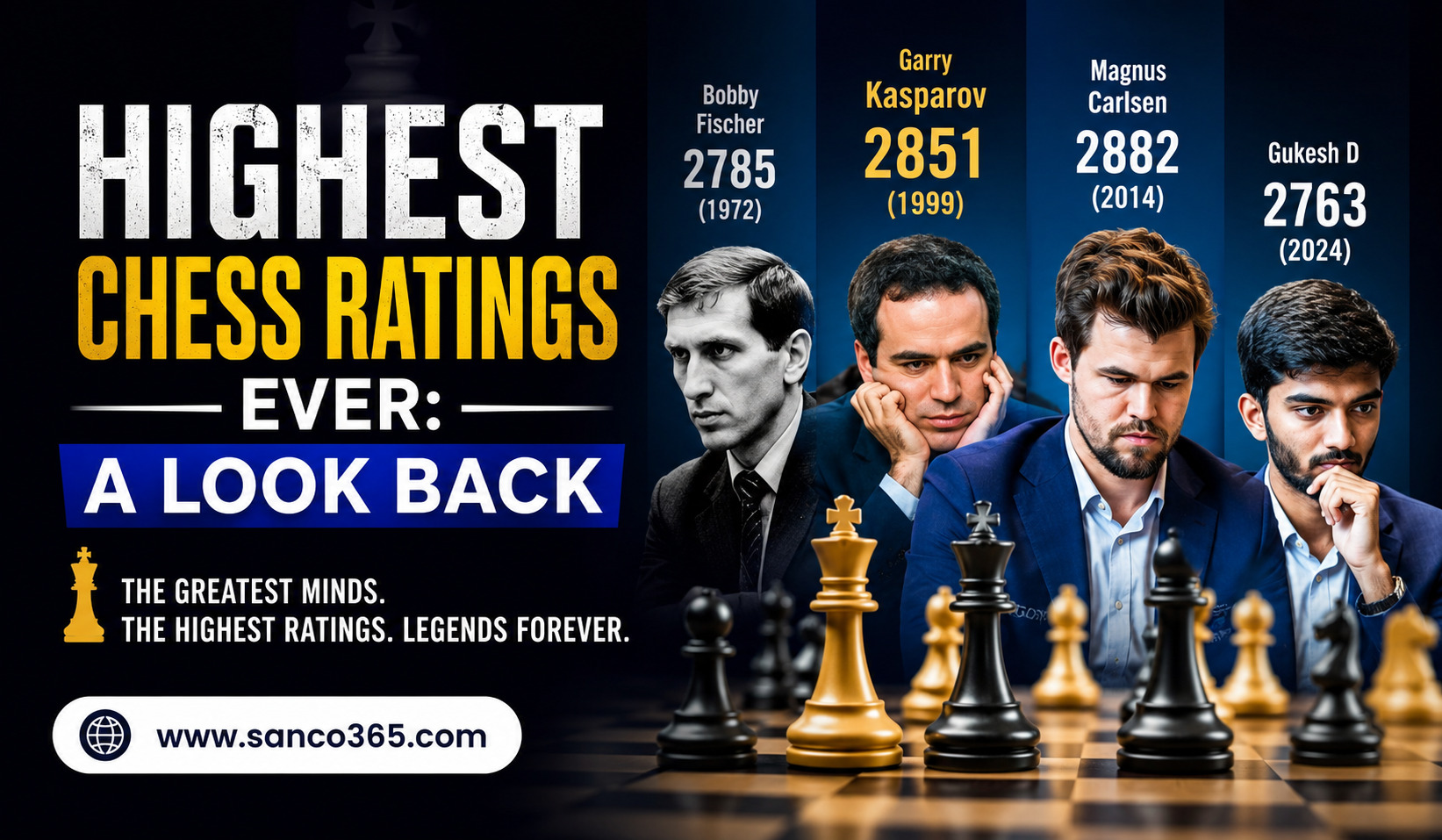
One number tells you almost everything about a chess player’s peak: 2882. That is the highest chess rating ever recorded on an official FIDE list, and more than a decade later, nobody has come within 40 points of touching it. This post digs into how that number came to be, who else has flirted with chess history, and why the highest chess rating ever keeps standing as the sport’s most stubborn benchmark.
What The Rating Number Actually Measures
Before ranking anyone, it helps to know what a rating is actually counting. FIDE, the sport’s global governing body, uses a version of the Elo system, named after physicist Arpad Elo, to track a player’s results against rated opposition. Win against a strong player and your number climbs. Lose to a weaker one and it drops harder than it would against a peer.
Ratings move every month based on tournament results, and they compound over a career. That is why a single hot event will not, by itself, produce the highest chess rating ever. You need years of dominance stacked on top of each other, plus a run of tournaments where everything clicks at once.
Classical, Rapid, and Blitz Are Not The Same Race
People often lump all chess ratings together, but classical, rapid, and blitz each have separate lists. Classical is the format that decides the World Championship, so when commentators talk about the greatest chess rankings ever achieved, they are usually pointing at the classical number first. Rapid and blitz peaks are real records too, just less central to a player’s historical legacy.
The 2882 Rating That Changed The Conversation
In May 2014, Magnus Carlsen posted a rating of 2882 on the classical list. It remains, to this day, the highest chess rating ever recorded in the sport’s history. Carlsen was 23 years old at the time, already a world champion, and riding a stretch of tournament wins that felt less like streaks and more like a new normal.
What made that peak so hard to argue with was not just the number itself. It was the way Carlsen got there. He was not padding his rating against weak fields. He was beating the best players alive, repeatedly, in classical time controls where there is nowhere to hide a mistake.
Think of it like a marathoner who does not just win one race by a wide margin, but wins ten races in a row against the best fields in the world, each one shaving time off the last. That is closer to what building the highest classical chess rating in history actually looks like. It is not a fluke event, it is a sustained standard.
The Names Behind The Other Historic Peaks
Carlsen sits alone at the very top, but the list of players who have brushed against the ceiling of the highest chess rating ever is short and packed with legends. Here is a rough breakdown of how the all-time peak classical ratings stack up, based on widely reported historical figures:
- Magnus Carlsen, peak of 2882, reached in May 2014
- Garry Kasparov, peak in the low 2850s, reached around 1999, and the first player to ever cross 2800 back in January 1996
- Fabiano Caruana, peak in the mid 2840s, reached in 2014
- Levon Aronian, peak in the low 2830s
- Wesley So and Ding Liren, both with peaks in the 2800s during strong stretches of their careers
Note on precision: exact peak figures for Kasparov, Caruana, and others vary slightly depending on the source and the month referenced, so treat the numbers above as approximate historical benchmarks rather than exact to the point. Carlsen’s 2882 figure is the one number in this list that is consistently cited without dispute as the highest chess rating ever achieved.
Kasparov’s Role As The Original Ceiling-Breaker
It is worth slowing down on Kasparov here, because before Carlsen, Kasparov was the standard everyone measured themselves against. He was the first player to break 2800, a threshold that felt almost theoretical before he got there. For years afterward, his peak was treated as close to the practical limit of chess strength. Carlsen did not just beat that number, he redefined what people assumed the ceiling was.
Why The Highest Chess Rating Ever Has Not Been Broken Since
More than a decade has passed since Carlsen’s peak, and no player has come close to matching it. There are a few reasons this gap has held up.
First, rating pools grow deeper over time. There are more strong grandmasters today than there were in 2014, which means more chances to drop points against dangerous opposition. A rating run that once might have gone untouched now runs into a wider field of players capable of punishing a single slip.
Second, preparation has changed. Engines are stronger, opening theory is deeper, and players study each other’s games with tools that simply did not exist twenty years ago. That makes it harder for any single player to build the kind of surprise-driven winning streak that fuels a historic rating peak.
Third, and this one gets overlooked, Carlsen himself shifted priorities. He has spent recent years splitting focus across classical, rapid, blitz, and online events rather than chasing the classical peak rating full time. A player fully obsessed with breaking his own record might approach schedule and preparation differently than a player who has already proven the point and moved on to other goals.
How Current Top Players Compare To The Peak
As of mid-2026, Carlsen still holds the number one spot on the classical rating list, sitting in the 2830 to 2840 range depending on the month, which is well below his own 2882 peak but still comfortably ahead of the rest of the field. Hikaru Nakamura, Fabiano Caruana, and a cluster of players including Nodirbek Abdusattorov and Javokhir Sindarov round out the current top tier, generally sitting in the 2750 to 2810 range.
That gap between the current world number one and the all-time peak is the clearest evidence of just how difficult 2882 was to reach. Even Carlsen, on his best current form, is not operating at the level he hit in 2014. It says something about a record when the person who set it cannot currently match it himself.
Rapid And Blitz Peaks Worth Knowing
Carlsen’s dominance is not limited to classical chess. His peak rapid rating has been reported above 2900, another figure that stands well clear of the field. Blitz ratings fluctuate more due to the sheer volume of games played, but Carlsen has regularly sat at or near the top of that list too. No other player has built a comparable case across all three formats at once.
What It Would Take To Break The Record
Chasing the highest chess rating ever is not really about one great tournament. It requires a player to string together roughly a year or more of results where they are winning far more than they lose against the strongest fields available, without a bad month to drag the average back down.
A few things a challenger would likely need:
- A run of elite tournament invitations, since rating gains depend heavily on the strength of the opposition faced
- Near-total avoidance of upset losses over a long stretch, since one bad loss to a lower-rated player can erase weeks of gains
- Peak physical and mental form sustained across a full season, not just a single event
- Some amount of favorable scheduling luck, landing in tournaments against the right mix of opponents at the right time
That combination is rare enough that it may explain why, more than ten years on, the record from 2014 is still standing.
Frequently Asked Questions
What is the highest chess rating ever recorded?
The highest chess rating ever recorded on an official FIDE classical list is 2882, achieved by Magnus Carlsen in May 2014.
Who was the first player to reach a 2800 rating?
Garry Kasparov was the first player to cross the 2800 mark, doing so in January 1996, a milestone that stood as a near-mythical ceiling before Carlsen surpassed it years later.
Is Magnus Carlsen still the highest rated player in the world?
Yes, as of mid-2026 Carlsen remains the world number one on the classical rating list, though his current rating sits well below his 2882 peak from 2014.
Why has nobody broken Carlsen’s 2882 record?
Deeper competitive fields, stronger engine-assisted preparation across the board, and Carlsen’s own shift toward splitting focus across multiple formats have all made it harder for any player, including Carlsen himself, to match that 2014 peak.