Neha Patil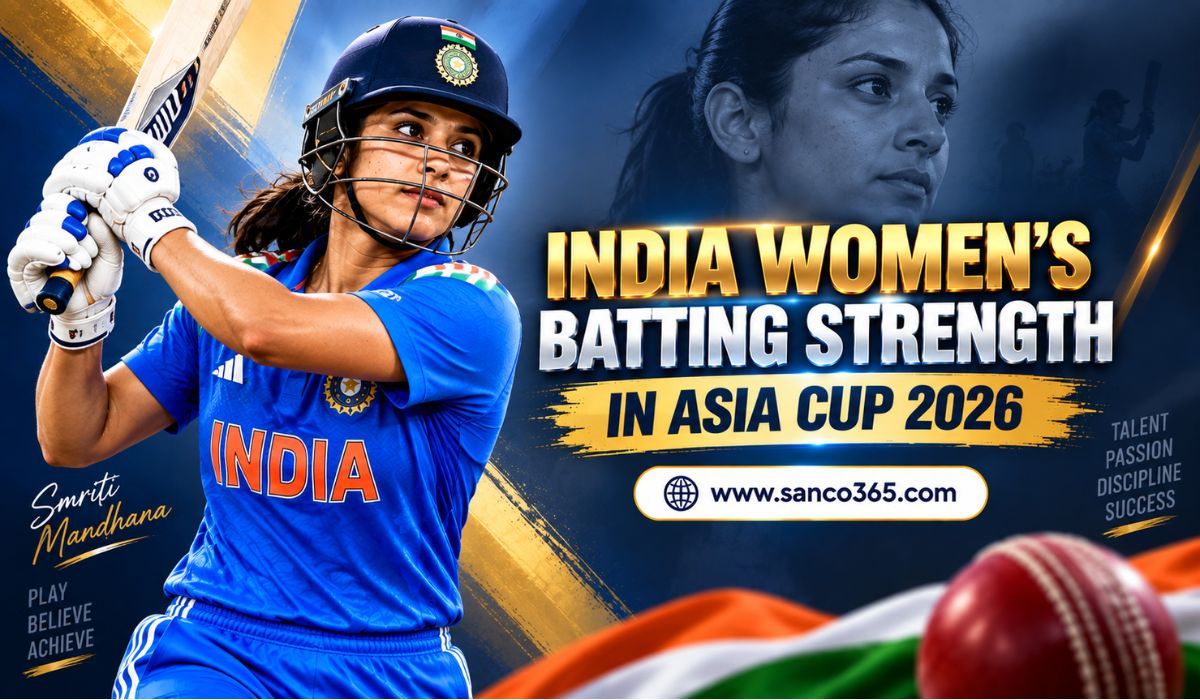
India Women have entered the knockout stage of the Women’s Asia Cup 2026 with one of the strongest batting line-ups in the tournament. Their unbeaten group-stage campaign has been built around aggressive opening partnerships, high scoring rates and the ability to produce match-changing innings when opportunities arise.
India won all three of their Group A matches against Thailand, Hong Kong and Pakistan. Their batting was particularly impressive in the 137-run victory over Hong Kong, when India scored 193/5, while their chase against Pakistan was completed with seven wickets in hand.
The team’s batting numbers also show why India are among the tournament favorites. Smriti Mandhana leads all batters with 152 runs, while Shafali Verma is second with 104. Both have strike rates above 176, giving India an unusually powerful combination at the top of the order.
Smriti Mandhana Leads India’s Batting Attack
Smriti Mandhana has been the biggest individual batting story of India’s Asia Cup campaign.
The left-handed opener has scored 152 runs in three innings at an average of 50.67 and a remarkable strike rate of 178.82. She also leads the tournament for boundaries, with 20 fours and seven sixes.
Her outstanding form was highlighted by a spectacular 124 against Hong Kong. Mandhana reached her century from just 64 balls, hitting 14 fours and seven sixes. Her innings helped India post 193/5 and eventually win the match by 137 runs.
The innings was also historically significant. Mandhana surpassed Mithali Raj’s record of 10,868 international runs and became the leading run-scorer in women’s international cricket. She also reached her 18th international century, moving to the top of the women’s international century list.
For India, however, the biggest value of Mandhana is her ability to control the tempo of an innings. She can attack during the powerplay but can also build a long innings when the team needs stability.
Shafali Verma Adds Explosive Power
If Mandhana provides a combination of timing and aggression, Shafali Verma brings even more immediate power.
Shafali has scored 104 runs in three innings during the tournament. Her strike rate of 176.27 is second only to Mandhana among the leading run-scorers, while she has already hit 12 fours and six sixes.
Her highest score is 64, which came against Thailand. She also scored 28 from 17 balls during India’s victory over Hong Kong, forming a 74-run opening partnership with Mandhana.
The combination of Mandhana and Shafali is therefore one of India’s greatest batting advantages.
Both players can score quickly, but they do so in slightly different ways. This makes it difficult for opposing bowlers to settle into a single strategy.
India’s Opening Partnership Sets the Tone
The importance of India’s opening pair cannot be overstated.
Mandhana and Shafali have provided India with strong starts during the group stage, allowing the middle order to enter situations where the team already has momentum.
Against Hong Kong, their 74-run partnership immediately placed India in control. Mandhana then accelerated further after Shafali’s dismissal and took the innings to another level.
A strong powerplay is particularly important in T20 cricket because it creates scoring opportunities while fielding restrictions are in place.
If India can regularly finish the first six overs with a high run rate and minimal wicket loss, their middle order can attack with greater freedom.
India’s Batting Has More Than Two Big Names
Although Mandhana and Shafali have dominated the headlines, India’s batting strength is not limited to their opening pair.
The squad has experienced middle-order options, wicketkeeping depth and all-rounders capable of contributing with the bat.
Harmanpreet Kaur remains one of India’s most experienced batters and can provide stability in the middle overs. Richa Ghosh offers an attacking option behind the main middle order, while Deepti Sharma provides valuable all-round depth.
This means opposition teams cannot simply focus their bowling plans on removing Mandhana and Shafali.
If India lose early wickets, they still have experienced players capable of rebuilding the innings.
Harmanpreet Kaur Brings Middle-Order Experience
Harmanpreet Kaur’s role becomes particularly important when the opening partnership does not produce a big total.
The Indian captain has extensive experience of playing under pressure and understands how to manage the tempo of an innings.
Her ability to attack both pace and spin means she can adapt depending on the match situation.
If India are 50 or 60 runs ahead of where they expected to be after the powerplay, Harmanpreet can attack. If early wickets fall, she can instead focus on rebuilding.
That flexibility is valuable in a knockout match where every wicket can carry additional pressure.
Richa Ghosh Can Provide Late-Innings Acceleration
Richa Ghosh adds another dimension to India’s batting.
The wicketkeeper-batter is capable of scoring quickly and can be especially valuable during the final overs.
T20 innings often require a final acceleration between overs 15 and 20, and Richa has the attacking game to fulfil that role.
Her presence also gives India flexibility in their batting order. Depending on the match situation, she can be promoted if India need more aggression or held back for the finishing phase.
That tactical flexibility adds to India’s batting depth.
Deepti Sharma Gives India All-Round Balance
Deepti Sharma’s contribution with the bat may not be as prominent as Mandhana’s or Shafali’s, but her all-round ability is an important part of India’s batting structure.
She can provide useful runs in the middle and lower order while also giving the team an additional bowling option.
This means India do not necessarily need all of their specialist batters to produce big scores in every match.
If the top order produces a strong total, Deepti can add finishing runs. If wickets fall early, she can provide stability.
That versatility is one of the reasons India have such a balanced squad.
Pratika Rawal Provides Another Batting Option
Pratika Rawal has also contributed during the tournament and gives India another option in the batting lineup.
She has scored 36 runs across three innings, with a strike rate of 109.09.
Her numbers may not compare with Mandhana or Shafali, but her role becomes more important if India need greater stability in the middle order.
The semi-final against Bangladesh could provide another opportunity for Rawal to make a significant contribution.
A strong innings from her would reduce India’s dependence on the opening pair and give the team even more batting depth.
India’s Boundary-Hitting Ability Is a Major Advantage
India’s batting strength can also be seen through their boundary numbers.
Mandhana has already hit 20 fours and seven sixes, while Shafali has 12 fours and six sixes.
That means India’s two leading batters have already combined for 32 fours and 13 sixes.
Boundary-hitting is particularly valuable in T20 cricket because it allows teams to maintain a high scoring rate without relying entirely on running between the wickets.
When Mandhana and Shafali are together, opposition bowlers have to protect both sides of the boundary while also trying to prevent singles.
That creates pressure from the beginning of an innings.
Strike Rate Makes India Particularly Dangerous
India’s batting isn’t only about accumulating runs. The speed at which those runs are scored is equally impressive.
Mandhana currently has a strike rate of 178.82, while Shafali is at 176.27. Both are among the highest in the entire tournament.
This allows India to reach competitive totals quickly.
A high scoring rate also gives the middle order more opportunities to attack because the team does not need to rebuild the entire innings from a low base.
The Hong Kong Match Was the Perfect Example
India’s match against Hong Kong demonstrated the full potential of their batting unit.
After being asked to bat first, India reached 193/5. Mandhana’s 124 was obviously the headline contribution, but the platform created by the opening partnership was also important. Shafali’s 28 from 17 balls helped India make an aggressive start.
The final score gave India a massive total to defend.
Their bowlers then dismissed Hong Kong for 56, producing a 137-run victory.
For India, the match showed what happens when their batting and bowling units perform at the same time.
The Pakistan Match Showed Another Side of India’s Batting
India’s victory over Pakistan was very different.
Pakistan were bowled out for only 55, leaving India with a tiny target to chase.
India lost three wickets during the chase, but they still completed the seven-wicket victory comfortably.
This was important because it demonstrated that India’s batting unit can remain composed even when early wickets fall.
Not every match requires a huge total. Sometimes the key is simply completing the chase efficiently.
India’s Middle Order Is the Main Area to Watch
Despite their impressive campaign, India’s batting does have an area that could be tested in the knockout stage.
A significant portion of India’s tournament runs has come from Mandhana and Shafali. Recent analysis noted that the pair accounted for 62.6% of India’s runs in the Asia Cup heading into the semi-final.
That statistic highlights the importance of the middle order.
Against stronger opposition, India may not always receive a big opening partnership. If Bangladesh take early wickets, players such as Harmanpreet Kaur, Richa Ghosh, Deepti Sharma and Pratika Rawal will need to take greater responsibility.
The good news for India is that these players have the experience to handle that pressure.
Bangladesh Could Target India’s Top Order
India’s semi-final against Bangladesh provides an interesting tactical battle.
Bangladesh will know that removing Mandhana and Shafali early could significantly change the match.
The Indian openers have been responsible for a large percentage of the team’s scoring, so Bangladesh’s bowlers are likely to attack them rather than simply trying to contain them.
India, meanwhile, will want their openers to survive the early overs and take advantage of scoring opportunities.
The opening battle could therefore have a major influence on the semi-final.
India’s Ability to Adapt Will Be Important
Knockout cricket often requires teams to change their approach.
India cannot assume that every match will produce the same batting conditions as their game against Hong Kong.
If the pitch is slow, the batters may need to work harder for boundaries. If Bangladesh bowl well in the powerplay, India may need to focus on rotating the strike.
This is where experienced players such as Mandhana and Harmanpreet become particularly valuable.
The ability to change tempo without losing wickets could be just as important as hitting boundaries.
India Have Multiple Ways to Build a Total
One of India’s biggest batting advantages is that they can construct an innings in several different ways.
They can attack immediately through Shafali.
They can rely on Mandhana’s combination of timing and power.
They can use Harmanpreet to control the middle overs.
They can rely on Richa Ghosh for late acceleration.
They can also receive useful contributions from all-rounders such as Deepti Sharma.
This variety makes India’s batting difficult to predict.
What India Need From Their Batters in the Knockout Stage
The Indian batting lineup does not necessarily need every player to score heavily.
The biggest requirement is for the top order to provide a strong foundation while the middle order delivers when required.
Mandhana and Shafali will look to maintain their aggressive approach without taking unnecessary risks.
The middle order will need to be ready for two very different situations: either consolidating after early wickets or accelerating after a strong start.
Richa and Deepti could become particularly important during the final overs.
The Pressure of the Semi-Final
India enter the semi-final against Bangladesh as favorites, but knockout cricket creates additional pressure.
A team that has dominated the group stage can suddenly find itself under pressure after losing two quick wickets.
This is why India’s batting depth could be just as important as their headline performers.
The team has already demonstrated that it can recover from setbacks. The Pakistan chase, for example, saw India lose three wickets but still finish comfortably.
That experience should help them deal with pressure in the semi-final.
India’s Batting Numbers Compare Favorably
The current tournament statistics make India’s batting strength clear.
Mandhana is the leading run-scorer with 152 runs, followed by Shafali with 104. They are also ranked first and second for strike rate among the leading batters, at 178.82 and 176.27 respectively.
Mandhana also owns the highest individual score of the tournament with 124, while Shafali’s 64 is the second-highest.
Those numbers explain why India have been able to produce such convincing results.
The Batting Unit Can Decide India’s Title Chances
India’s bowling attack has been excellent, but the batting unit could ultimately decide whether they win the tournament.
If Mandhana and Shafali continue their current form, India can put opposition teams under pressure from the first over.
If the middle order begins contributing more consistently, the team becomes even harder to defeat.
That combination would give India the kind of batting depth required to win knockout matches.
Final Thoughts
India Women’s batting strength has been one of the defining features of their Asia Cup 2026 campaign. The team has completed the group stage unbeaten, with Smriti Mandhana and Shafali Verma providing an exceptionally aggressive opening combination.
Mandhana leads the tournament with 152 runs at an average of 50.67 and a strike rate of 178.82, while Shafali has scored 104 runs at a strike rate of 176.27.
Mandhana’s record-breaking 124 against Hong Kong was the standout individual performance, while Shafali’s aggressive starts have helped India establish momentum at the top of the order.
The main question heading into the knockout stage is whether India’s middle order can provide greater consistency if the openers fail to produce another big partnership.
Harmanpreet Kaur, Richa Ghosh, Deepti Sharma and Pratika Rawal all have the opportunity to answer that question.
With India facing Bangladesh in the semi-final, the team’s batting will once again come under the spotlight. If the opening pair continues its remarkable form and the middle order steps up when needed, India will have one of the most dangerous batting units remaining in the Women’s Asia Cup 2026.