sanco365seo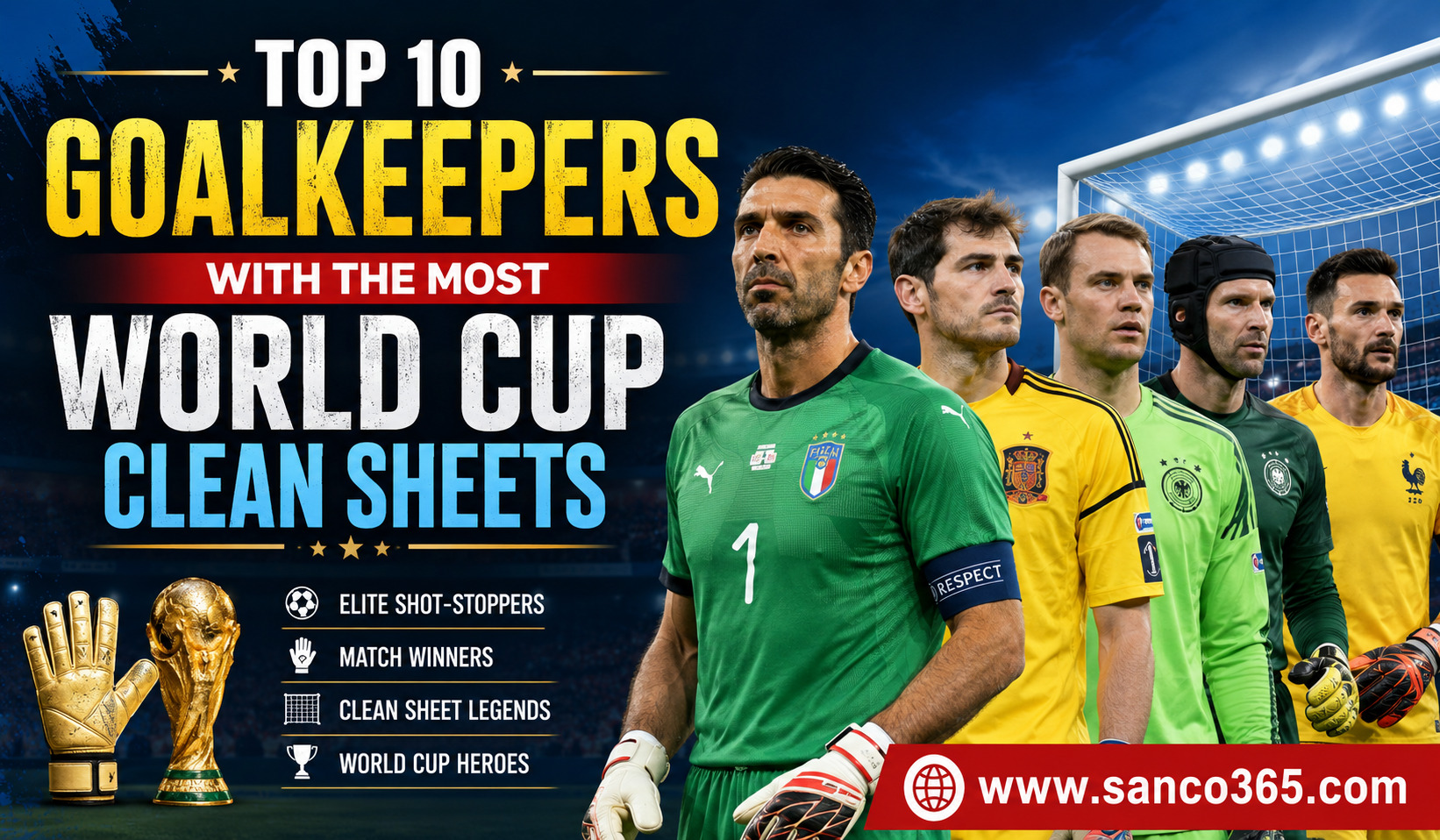
Two goalkeepers have stood at the summit of World Cup clean sheets for decades, and no one has managed to knock either of them off since. Between them, Fabien Barthez and Peter Shilton kept the ball out of the net ten times each on football’s biggest stage, a mark that has survived generations of elite shot stoppers. This is the story of the ten men who built their World Cup legacies not on goals scored, but on goals denied.
What Actually Counts as a World Cup Clean Sheet?
Before ranking anyone, it helps to define the terms. A clean sheet in this context means a goalkeeper played a full match at the FIFA World Cup, in normal time or extra time, without conceding a goal. Penalty shootouts do not count toward or against the tally, since shootouts sit outside the run of play. That distinction matters because a goalkeeper can lose a shootout and still walk away with a clean sheet on his record, which sounds strange until you remember the 1990 semi-final between England and West Germany.
World Cup clean sheets are also harder to accumulate than a club season’s worth, simply because the tournament only comes around every four years and knockout football punishes even a single defensive lapse. A goalkeeper needs three things working in his favor: a strong national team in front of him, a manager who trusts him across multiple tournaments, and a bit of luck when it comes to injuries and squad rotation.
The Two Men Who Share the All-Time Record
1. Fabien Barthez, France’s Wall in 1998
Fabien Barthez sits joint top of the all-time list with ten clean sheets across seventeen World Cup appearances, spread over three tournaments. He kept five clean sheets during France’s triumphant home campaign in 1998, added one more in 2002, and closed out his international career with four during the 2006 run to the final in Germany. Barthez was never the tallest goalkeeper in world football, but his reading of the game and his willingness to sweep well outside his box made him a genuine outlier for his era.
2. Peter Shilton, England’s Iron Curtain
Peter Shilton matches Barthez with ten clean sheets, also across seventeen appearances, though his came over three separate World Cups between 1982 and 1990. He kept four clean sheets in 1982, three in 1986, and three more in 1990 as England reached the semi-final against West Germany at the age of forty. What stands out about Shilton’s run is a stretch of five hundred minutes without conceding a goal across his first two tournaments, a streak that ranks second only to Italy’s Walter Zenga in World Cup history. Shilton’s longevity, playing every minute of England’s 1990 campaign at an age when most goalkeepers have long retired, remains one of the more remarkable feats of endurance the tournament has produced.
The Chasing Pack: Five Keepers Locked on Eight Clean Sheets
A tier below the leading pair sits a group of five goalkeepers who each finished their World Cup careers with eight clean sheets, though they reached that number in very different numbers of matches. This is where the efficiency argument gets interesting, because raw totals do not always tell you who was harder to beat.
- Sepp Maier (West Germany), eight clean sheets in eighteen appearances, the backbone of the side that won the 1974 World Cup on home soil and delivered a masterclass against Johan Cruyff’s Netherlands in that final.
- Emerson Leão (Brazil), eight clean sheets in just fourteen appearances across the 1974 and 1978 tournaments, proof that Brazilian football was never only about attacking flair.
- Claudio Taffarel (Brazil), eight clean sheets spread across the 1994, 1998, and 2002 tournaments, including the shutout that helped Brazil lift the trophy in the United States.
- Hugo Lloris (France), eight clean sheets in a record twenty appearances, more caps for a goalkeeper than anyone else in World Cup history, built while captaining France to the 2018 title and the 2022 final.
- Jan Jongbloed (Netherlands), eight clean sheets in only twelve matches, the best conversion rate of anyone near the top of this list, earned while helping the Dutch reach back to back finals in 1974 and 1978 without ever lifting the trophy.
Jongbloed’s numbers deserve a second look. Think of him like a striker who scores at nearly a goal a game rather than one who needs twenty shots to get there. Fewer appearances, same output, arguably a stronger case for efficiency than anyone else on this list.
The Modern Era Trio Closing the Gap
Three more names round out the top ten, each with seven clean sheets and each a familiar face to anyone who has watched World Cup football in the last two decades.
Iker Casillas kept seven clean sheets across seventeen appearances for Spain between 2002 and 2014, including the tournament that mattered most, Spain’s 2010 triumph in South Africa, where his save against Arjen Robben in the final is still replayed whenever this conversation comes up. Manuel Neuer also has seven clean sheets, gathered over a record nineteen appearances for Germany, and his sweeper-keeper style in Brazil in 2014 is widely considered one of the more transformative individual performances the position has seen at World Cup level. Thibaut Courtois completes the trio with seven clean sheets for Belgium, built during Belgium’s golden generation runs to the semi-final in 2018 and the knockout rounds beyond.
What ties this group together is appearance count. All three played more World Cup matches than Barthez or Shilton, yet none has closed the clean sheet gap, which says something about how much tighter and more attack-minded the modern game has become.
Why Clean Sheets Tell Only Half the Story
Ranking goalkeepers purely on clean sheets rewards two things that have nothing to do with individual quality: playing for a strong defensive team and reaching the knockout rounds repeatedly. A goalkeeper for a team that gets eliminated in the group stage simply does not get enough matches to build a big number, no matter how well he plays. That is part of why efficiency numbers, clean sheets divided by matches played, matter just as much as the raw totals when comparing eras.
It is also worth remembering that a clean sheet is a team stat wearing a goalkeeper’s name. Barthez had Marcel Desailly and Laurent Blanc in front of him. Shilton had Terry Butcher marshalling England’s back line. Great World Cup goalkeepers rarely operate in isolation, and the best of them tend to make the players around them better rather than simply mopping up after mistakes.
Who Could Break Into the Top 10 at the 2026 World Cup?
The current generation of World Cup goalkeepers has a real chance to reshape this list over the coming tournaments. Emiliano Martínez won the Golden Glove in 2022 after keeping three clean sheets during Argentina’s title run, and further deep runs would push him toward the established names above. Younger shot stoppers who have already shown themselves capable of long international careers will need multiple tournaments and multiple knockout runs before they can seriously threaten Barthez and Shilton’s mark of ten, but the gap is not as far away as it once looked.
Frequently Asked Questions
Who has the most World Cup clean sheets of all time?
Fabien Barthez of France and Peter Shilton of England share the record with ten clean sheets each, both achieved across seventeen World Cup appearances.
Does a penalty shootout count against a goalkeeper’s clean sheet record?
No. Clean sheet totals only account for goals conceded in normal time and extra time. A goalkeeper can lose a shootout and still be credited with a clean sheet for that match.
Who has the most World Cup appearances by a goalkeeper?
Hugo Lloris of France holds the record with twenty World Cup appearances, ahead of Manuel Neuer of Germany on nineteen.
Which goalkeeper has the best clean sheet rate relative to matches played?
Jan Jongbloed of the Netherlands stands out here, with eight clean sheets in just twelve World Cup appearances, the strongest ratio among goalkeepers near the top of the all-time list.