sanco365seo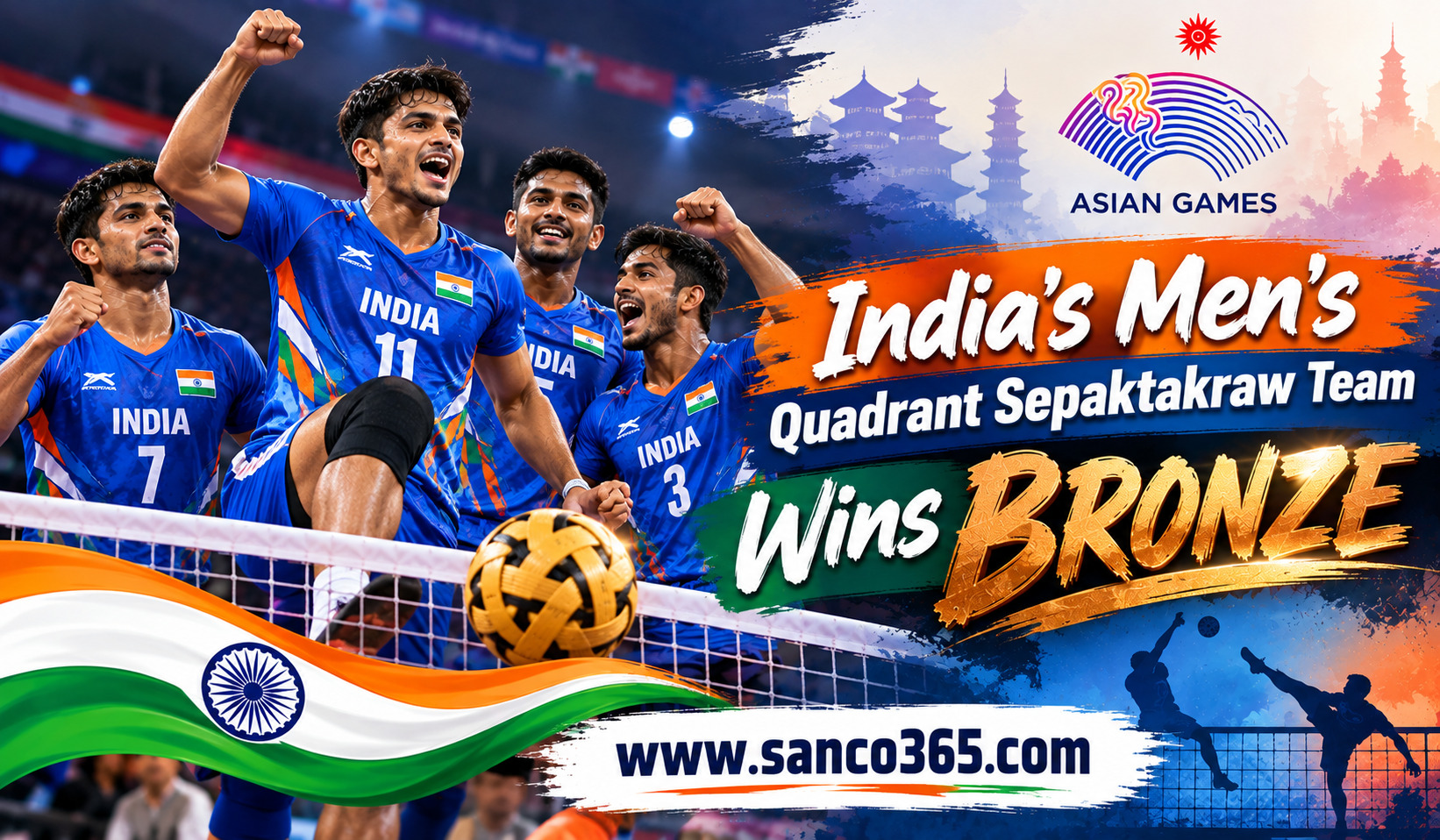
Two points stood between India and the gold medal match on October 2, 2026. Hosts Japan squeezed out a 15-12, 15-13 victory in a thrilling semifinal duel at the Nagoya City Mizuho Park Gymnasium. Yet the headlines across Asian sport were clear: India’s men’s quadrant sepaktakraw team wins bronze after an extraordinary campaign in Japan.
That semifinal loss hurt, but it couldn’t dim the shine of a historic run. India tore through Group A with three straight victories, including a massive upset over world champions Myanmar. This podium finish marks India’s first-ever medal in the quadrant discipline at the Asian Games.
Here’s the full breakdown of how four quarter-court fighters pushed Indian sepaktakraw onto the podium. We’ll examine the group stage shockers, the leg-splitting rallies, and what this medal means for the future.
Semi-Final Thriller: How Japan Edged India in Nagoya
Japan entered the Mizuho Park Gymnasium as group stage runners-up, but they brought home-court heat. India matched them kick for kick in a fierce opening set.
Yuki Sato and Ryota Haruhara landed heavy bike-kicks for Japan early on. India stayed close through sharp net defending from Akash Yumnam and Ram Kumar Sharma.
Japan snatched the opening set 15-12 after two late defensive errors from the Indian side. The home crowd cheered loudly, but India refused to fade away.
High-Stakes Battles at the Net
The second set produced the best rallies of the entire tournament. Malemnganba Singh Sorokhaibam sparked a late Indian rally with two back-to-back sunback spikes.
With the score locked at 13-13, Japan’s Wataru Narawa executed a precise block at the tape. Japan grabbed the final two points to close out the set 13-15.
Despite the narrow 0-2 loss, India locked up a historic bronze medal as losing semifinalists. The official result ended a nail-biting 42-minute battle on the court.
Match Summary: India vs Japan Semifinal
- First Set Score: Japan won 15-12.
- Second Set Score: Japan won 15-13.
- Match Duration: 42 minutes of continuous high-flying action.
- Top Indian Scorer: Malemnganba Singh Sorokhaibam with 11 attack points.
- Key Japanese Players: Yuki Sato, Ryota Haruhara, Wataru Narawa, Yota Ichikawa.
Group Stage Rampage: How India Swept Group A
India didn’t just qualify for the knockout rounds; they dominated the hardest group in Nagoya. Group A featured traditional powerhouses, including reigning World Cup champions Myanmar.
The Indian squad opened their tournament with a clean sweep of Laos. That quick victory settled pre-tournament nerves and set up a crucial clash against Vietnam.
Against Vietnam, India showed relentless energy in the backcourt. Bobby Kumar controlled the service line while Lokhon Singh Elangbam came off the bench to close out set two.
Taking Down the World Champions
The defining moment of the tournament came against Myanmar. Few experts expected India to push the World Cup champions to the brink, let alone win.
India lost the first set 11-15 after early service errors. They answered by taking the next two sets 15-10 and 15-12 in a huge upset.
That victory gave India top spot in Group A with a perfect 3-0 record. It proved that India’s squad belonged among Asia’s true contenders.
Group A Results Table
- Match 1: India defeated Laos 2-0 (15-9, 15-11).
- Match 2: India defeated Vietnam 2-0 (15-10, 15-12).
- Match 3: India defeated Myanmar 2-1 (11-15, 15-10, 15-12).
- Group Position: 1st place (3 wins, 0 losses, +4 set differential).
India’s Men’s Quadrant Sepaktakraw Team Wins Bronze Behind Key Roster
Quadrant sepaktakraw demands total coordination across all four court spots. A single weak link can ruin a team’s defensive rotation.
India’s starting unit displayed chemistry built over months of intense training camps. Each player brought a specific skillset to the floor in Nagoya.
Primary Starters and Defensive Pillars
Malemnganba Singh Sorokhaibam served as India’s primary striker. His explosive airborne rotation allowed him to hammer spikes over multi-man blocks.
Ram Kumar Sharma locked down the middle of the court. His quick reactions prevented easy drop shots from reaching the floor.
Bobby Kumar directed the service game with accuracy and pace. Beside him, Akash Yumnam provided high-flying block coverage at the net tape.
Tactical Depth on the Bench
Substitutes Lokhon Singh Elangbam and Tekong Arun played vital minutes throughout the tournament. Coach tactics required fresh legs during long three-setters.
Elangbam brought strong defensive resets whenever opponents targeted India’s backline. Arun stepped in to alter service rhythms against fast-paced teams.
Their combined efforts created a flexible rotation system that wore down opposing defenders. Depth proved crucial during back-to-back group matches.
Full Indian Quadrant Roster
- Malemnganba Singh Sorokhaibam: Primary Striker / Feeder
- Ram Kumar Sharma: Defender / Middle Blocker
- Bobby Kumar: Server / Backcourt Specialist
- Akash Yumnam: Net Blocker / Secondary Attacker
- Lokhon Singh Elangbam: Tactical Substitute / Defender
- Tekong Arun: Tactical Substitute / Server
Historical Context: India’s Third Asian Games Sepaktakraw Medal
Sepaktakraw joined the Asian Games program back at Beijing 1990. For decades, Southeast Asian nations like Thailand and Malaysia owned the podium.
India broke through that barrier at Jakarta 2018 by winning men’s regu bronze. The women’s team followed suit in Hangzhou 2023 with a regu bronze of their own.
The Nagoya success marks India’s third total medal in the sport. More importantly, it is the nation’s first quadrant medal in Asian Games history.
The Rise of Quadrant Sepaktakraw
Quadrant play was added to the Asian Games to increase fast-paced rallies. Four players on court mean less open space and faster reactions.
Indian coaches shifted focus toward quadrant tactics three years ago. That strategic choice produced immediate results on the international stage.
The gap between India and top Asian teams continues to shrink. Success in Nagoya confirms that Indian sepaktakraw is making serious strides.
India’s All-Time Asian Games Sepaktakraw Medals
- Jakarta 2018: Bronze Medal (Men’s Team Regu)
- Hangzhou 2023: Bronze Medal (Women’s Team Regu)
- Aichi-Nagoya 2026: Bronze Medal (Men’s Quadrant)
- Total Medal Tally: 3 Bronze Medals across three consecutive Games.
Tactical Breakdown: How the Quadrant Game Was Played
Quadrant sepaktakraw differs greatly from traditional three-player regu events. The smaller open court requires instant decision-making and flawless court coverage.
Servers can’t simply rely on speed. They must place the rattan ball deep into corners to throw off the opponent’s setting pattern.
India mastered the transition from defensive digs to immediate attack sets. That quick-strike ability kept defenders on their heels throughout the tournament.
Mastering the Sunback Spike and Block
The sunback spike remains the most lethal offensive weapon in sepaktakraw. Strikers leap backward into the air, kicking the ball overhead while completely inverted.
Sorokhaibam scored over 40% of India’s total points using this acrobatic move. His timing over Japanese blockers kept sets close in the semifinal.
On defense, India utilized coordinated wall blocks at the net. Yumnam and Sharma combined to shut down straight-line attacks from opposing feeders.
Strategic Elements That Decided Matches
- Service Placement: Targeting weak backhand receivers during clutch points.
- Transition Speed: Converting digs into overhead sets within two touches.
- Block Timing: Jumping late to counter high-angle sunback spikes.
- Rotation Management: Using bench players to maintain high jumping power.
The Future: What Lies Ahead for Indian Sepaktakraw
A single medal can change the trajectory of an entire national sports program. This result in Japan brings fresh attention to a rising discipline.
State associations in Manipur, Nagaland, and Delhi are expanding youth academies. More young athletes are picking up the rattan ball than ever before.
The Sports Authority of India continues to fund international exposure trips. Regular matches against Thailand and Malaysia remain critical for further growth.
Building Toward Global Competition
The immediate target for this squad is the upcoming Sepaktakraw World Cup. Indian players want to turn Asian Games bronze into global silverware.
Coaches plan to refine second-line defense and service consistency. Reducing unforced errors will be the main focus in upcoming training camps.
Seeing how India’s players battled in Nagoya proves that Indian sports can compete for global titles. The era of being underdogs is officially ending.
Immediate Focus Areas for the National Program
- Youth Talent Identification: Expanding scouting across northeastern states.
- International Exposure: Scheduling more friendly series in Southeast Asia.
- Video Analysis: Studying opponent server habits before major tournaments.
- Unforced Error Reduction: Improving set accuracy in high-pressure rallies.
Key Takeaways
- Bronze Medal Victory: India secured a historic bronze medal in men’s quadrant sepaktakraw at Nagoya 2026.
- Group Stage Dominance: India topped Group A by defeating Laos, Vietnam, and World Cup champions Myanmar.
- Semifinal Heartbreak: India lost a tight 0-2 match (12-15, 13-15) against host nation Japan.
- Historical Milestone: This represents India’s third Asian Games sepaktakraw medal and first-ever in the quadrant discipline.
- Core Roster: The team featured Sorokhaibam, Sharma, B. Kumar, Yumnam, Elangbam, and Arun.
FAQs
What was the final score in India’s semifinal match against Japan?
India lost 0-2 to Japan with set scores of 12-15 and 13-15 at the Nagoya City Mizuho Park Gymnasium.
Who were the players on India’s men’s quadrant sepaktakraw team?
The roster featured Malemnganba Singh Sorokhaibam, Ram Kumar Sharma, Bobby Kumar, Akash Yumnam, Lokhon Singh Elangbam, and Tekong Arun.
How many sepaktakraw medals has India won in Asian Games history?
India has won three total bronze medals in Asian Games sepaktakraw history across the 2018, 2023, and 2026 events.
Which teams did India defeat during the group stage in Nagoya?
India defeated Laos, Vietnam, and World Cup champions Myanmar to top Group A with a perfect 3-0 record.
What is the difference between regu and quadrant sepaktakraw?
Regu features three players per team on court, while the quadrant discipline features four players per team.
Conclusion: A Turning Point for Indian Sepaktakraw
The news that India’s men’s quadrant sepaktakraw team wins bronze marks a monumental shift for court sports in India. Pushing host nation Japan to the absolute limit after conquering Group A showed incredible heart and technical maturity. With stars like Sorokhaibam leading a disciplined lineup, Indian sepaktakraw has earned its place among Asia’s elite. This bronze medal in Nagoya isn’t just a reward for hard work—it’s the launching pad for a bright new era on the court.