sanco365seo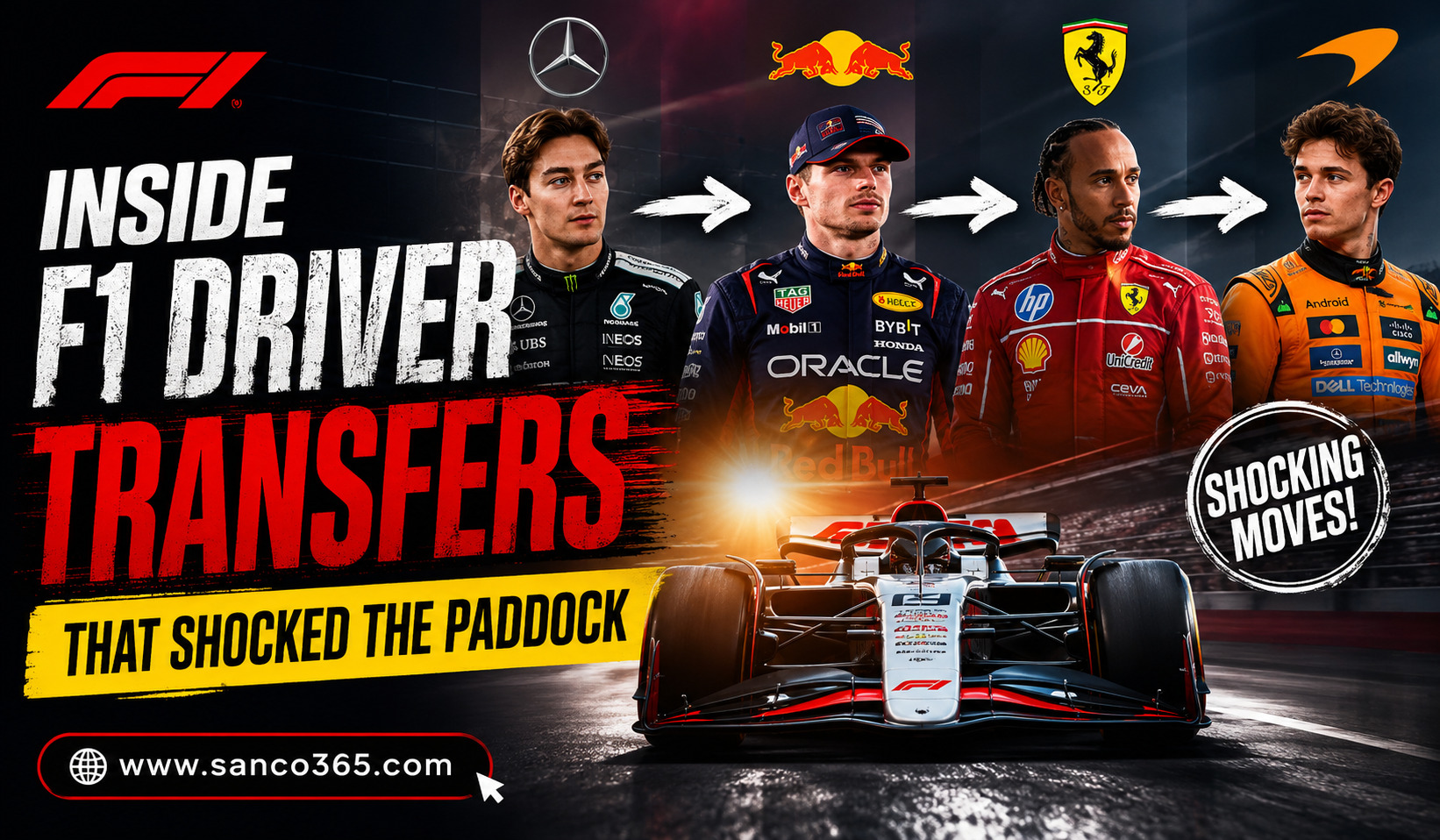
Formula 1 driver transfers do not happen often, but when they do, they rewrite championships and end friendships overnight. One phone call from Ferrari in early 2024 was enough to send shockwaves through every team principal’s office, and it reminded everyone why F1 driver transfers remain the sport’s most explosive off track storyline. This post breaks down the moves that changed everything, why they happened, and what they tell us about how driver contracts actually work behind the scenes.
Why F1 Driver Transfers Hit Differently Than Other Sports
In football or basketball, a star player switching teams is big news for a week, then life moves on. F1 driver transfers carry more weight because a driver is not just swapping a jersey. He is stepping into a completely different car, a different engineering philosophy, and a different internal culture built over years.
Think of it like a chef leaving a restaurant where the kitchen was built entirely around his technique, only to walk into a new kitchen with different ovens, different suppliers, and a sous chef who has run the place his own way for a decade. That adjustment period is brutal, and it is why some of the biggest F1 driver transfers in history took months, sometimes over a year, to actually pay off.
The stakes are also financial in a way most sports cannot match. A single seat change can shift hundreds of millions of dollars in sponsorship value, and it can decide whether a constructor wins or loses a championship worth tens of millions in prize money. That is why silly season, the unofficial term for F1’s transfer speculation period, dominates headlines from summer through the following year.
The Move That Broke The Internet: Hamilton To Ferrari
No recent transfer compares to Lewis Hamilton leaving Mercedes for Ferrari, announced in February 2024 and taking effect for the 2025 season. Hamilton had spent twelve years at Mercedes, winning six of his seven world titles there and forming one of the most successful driver-team partnerships the sport has ever seen.
The announcement blindsided almost everyone, including reportedly Mercedes team boss Toto Wolff, who found out shortly before the public did. This was not a driver chasing a struggling team out of desperation. Hamilton was still competitive, still one of the most recognizable athletes on the planet, and he chose to walk away from a car and a garage he knew intimately to join the team he grew up idolizing as a kid in Stevenage.
Key reasons this transfer stood out:
- It ended one of the longest and most decorated driver-team pairings in F1 history
- It happened at an age (39 entering 2025) when most drivers are winding down, not chasing new challenges
- It forced Ferrari to move Carlos Sainz out, who then had to scramble for a seat elsewhere
- It reshuffled the entire driver market in one domino effect, from Williams to Sauber to Red Bull’s junior program
Hamilton’s move to Ferrari showed that even at the peak of a legendary career, the emotional pull of a childhood dream team can outweigh the comfort of a proven winning formula.
Schumacher’s Leap Of Faith: Benetton To A Struggling Ferrari
Rewind to 1996. Michael Schumacher had just won back to back championships with Benetton in 1994 and 1995. Ferrari, by contrast, had not won a drivers’ title since Jody Scheckter in 1979. On paper, this transfer made no sense.
Schumacher took the deal anyway, reportedly for a contract that made him the highest paid driver in the sport at the time, but money was only part of the story. He believed he could rebuild Ferrari from the inside, and he brought key technical staff, including Ross Brawn and Rory Byrne, with him over the following seasons.
It took five years of frustration, retirements, and near misses before Schumacher finally delivered Ferrari’s first drivers’ title in over two decades in 2000. That patience turned into an unprecedented run of five consecutive championships. This remains the gold standard for how a single driver transfer can transform an entire organization, not just a results sheet.
What Made This Different From A Typical Rebuild
Most struggling teams sign a driver hoping he adapts to what already exists. Ferrari essentially let Schumacher rebuild the operation around himself, which is rare in a sport where engineering hierarchy usually outranks driver influence. That level of trust from Ferrari’s leadership is part of why this remains one of the most studied Formula 1 driver moves of all time.
Alonso’s Ferrari Chapter And His Restless Career
Fernando Alonso has never been shy about chasing a winning car, and his career reads like a case study in F1 silly season drama. He left Renault after back to back titles in 2005 and 2006 to join McLaren, a partnership that collapsed within a single, chaotic season involving teammate Lewis Hamilton and a spygate scandal that overshadowed the racing itself.
Alonso then returned to Renault briefly before signing with Ferrari in 2010, where he came agonizingly close to a title in his first season, losing out to Sebastian Vettel in the final race in Abu Dhabi. He spent five years at Maranello without ever winning that elusive third championship, before making the surprising call to join McLaren again in 2015, this time paired with a Honda engine that was so unreliable it prompted his now famous “GP2 engine” radio complaint.
More recently, Alonso shocked fans by leaving a competitive Alpine seat for Aston Martin in 2023, a team that had finished seventh in the constructors’ standings the year before. Aston Martin’s ambitious investment and Lawrence Stroll’s backing convinced Alonso the upside was worth the gamble, and the team’s sudden competitiveness in early 2023 validated that bet, at least for a season.
Verstappen’s Mid-Season Promotion Shocked The Grid
Not every dramatic transfer happens in the off season. In May 2016, Red Bull made the almost unheard of decision to promote Max Verstappen from Toro Rosso to the main Red Bull team just four races into the season, swapping him with Daniil Kvyat.
Verstappen was nineteen years old at the time. He won his very first race for Red Bull at the Spanish Grand Prix, becoming the youngest race winner in F1 history at that point. That single mid-season swap set the trajectory for what became four consecutive drivers’ championships for Verstappen between 2021 and 2024, and it reshaped how teams think about promoting young talent under pressure rather than waiting for a new season to make the call.
Perez, Sainz, And The Ripple Effect Of Modern Silly Season
Modern shocking F1 transfers rarely happen in isolation anymore. When one top seat opens, it triggers a chain reaction across the entire grid. The Hamilton to Ferrari move is the clearest recent example.
Here is how that single transfer rippled outward:
- Carlos Sainz lost his Ferrari seat and eventually signed with Williams for 2025
- Williams’s incumbent driver situation shifted, affecting other midfield contracts
- Red Bull’s junior driver pipeline, including Liam Lawson, saw new opportunities open up as teams reshuffled
- Sauber, soon to become Audi’s works team, picked up young talent partly because established drivers were locked into other moves
Sergio Perez’s situation at Red Bull tells a similar story about how quickly form and team politics can turn a “safe” seat into an uncertain one. Perez won multiple races in 2023 but struggled badly through parts of 2024, and speculation about his future became a constant subplot even while he remained under contract, showing how driver market pressure now exists almost year round rather than just during the traditional summer break.
FAQ: Common Questions About F1 Driver Transfers
How often do F1 drivers change teams?
There is no fixed rule, but most contracts run one to three years, and it is common for at least two or three seats to change hands each season. Some drivers, like Fernando Alonso, have driven for more than five different constructors across their career.
Can F1 drivers switch teams mid-season?
Yes, though it is rare. Max Verstappen’s 2016 promotion from Toro Rosso to Red Bull is the most famous modern example. Mid-season swaps usually require the driver’s current team to release him from contract, which teams are typically reluctant to do.
Why do top F1 drivers sometimes join weaker teams?
Reasons vary. Some drivers chase a childhood dream team, as Hamilton did with Ferrari. Others see genuine technical upside and investment, as Alonso did with Aston Martin. Financial packages and long term project control also play a role.
Who decides F1 driver contracts and transfers?
Team principals and ownership groups negotiate directly with drivers and their management, though driver academies (like Red Bull’s junior program) also influence which young drivers get promoted into race seats.
Final Lap: What These Transfers Teach Us
Every one of these moves, from Schumacher’s leap of faith to Hamilton’s dream homecoming, proves the same point: F1 driver transfers are rarely about chasing the easiest path to a trophy. They are about legacy, timing, and a driver’s belief in what a team can become, not just what it already is.
Watching how the Hamilton to Ferrari story unfolds over the next few seasons will likely define this era of the sport, the same way Schumacher’s Ferrari years defined the early 2000s. Keep an eye on the 2026 regulation changes too, since major rule shifts almost always trigger another wave of driver market chaos as teams and drivers bet on who will adapt fastest.